
Platform · building
CommandOS
The command center that replaced this studio's whole SaaS stack — projects, client CRM, invoicing, notes and booking in one app.
- Year
- 2026
- Disciplines
- Product, platform engineering, integrations
- Stack
- Next.jsTypeScriptPostgresCloud-hosted
The brief
Stop renting the business.
Running a studio on rented software means the client list is in one tool, the invoices in another, the notes in a third, and every one of them charges per seat to read your own data back. CommandOS was built to collapse that: one Next.js app on our own box, holding the projects, the pipeline, the money and the knowledge, with the pieces a client touches published straight out of it.
What we built
- 01
One screen that answers "what now"
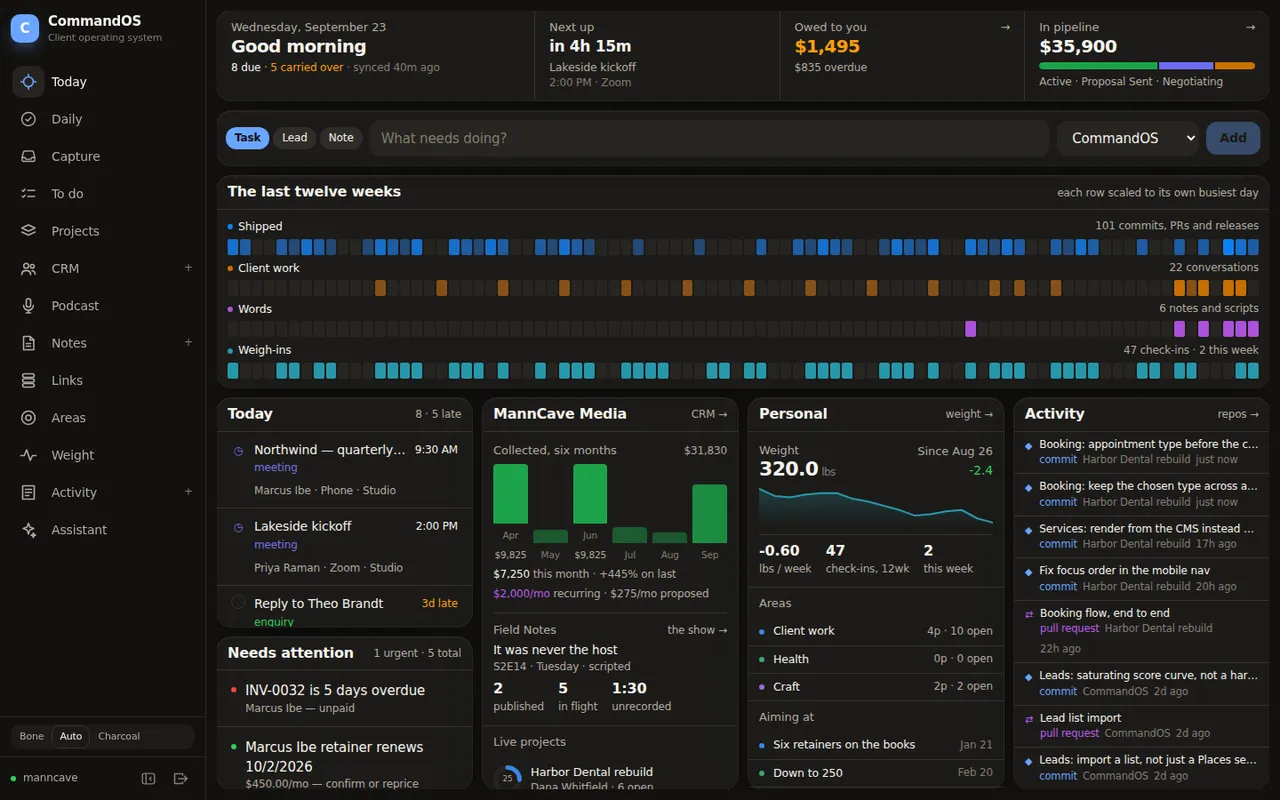
Today pulls what is due, who is waiting, what is owed and what moved since yesterday into a single view — the answer most dashboards make you assemble from four tabs.
- 02
A CRM that runs on real money
Clients by stage with deal value and time since last contact, wired straight to proposals and invoices — so the pipeline number and the money owed come from the same record rather than two systems that disagree.
- 03
Notes that know what they are about
A block editor whose notes link to the project and client they came out of, indexed into a knowledge graph so the connections are navigable instead of remembered.
- 04
The client-facing half, published
Booking pages, embeddable lead forms, proposals signed in the page and invoices with a payment link — all served by the same app, which is how the enquiry form on this site reaches it.
- 05
Integrations that report their own failures
GitHub activity per repository, calendar subscriptions, and mail resolved to the client it belongs to — each surfacing the reason for a failed sync rather than going quietly stale.
- 06
An assistant with a short list of hands
Claude reads everything and writes almost nothing: three tools can add a contact, log an interaction or amend a client, and that is the whole list. Nothing deletes, nothing touches money or a pipeline stage, and a name that matches two clients writes nothing and asks. The same guarded tools are exposed over an OAuth-protected MCP endpoint, so an outside agent can file a lead into the CRM. Every model call is priced to the token on its own page.
Screens
-
Today — Twelve weeks of shipping, clients, writing and weigh-ins on one axis, above the money and the day. -
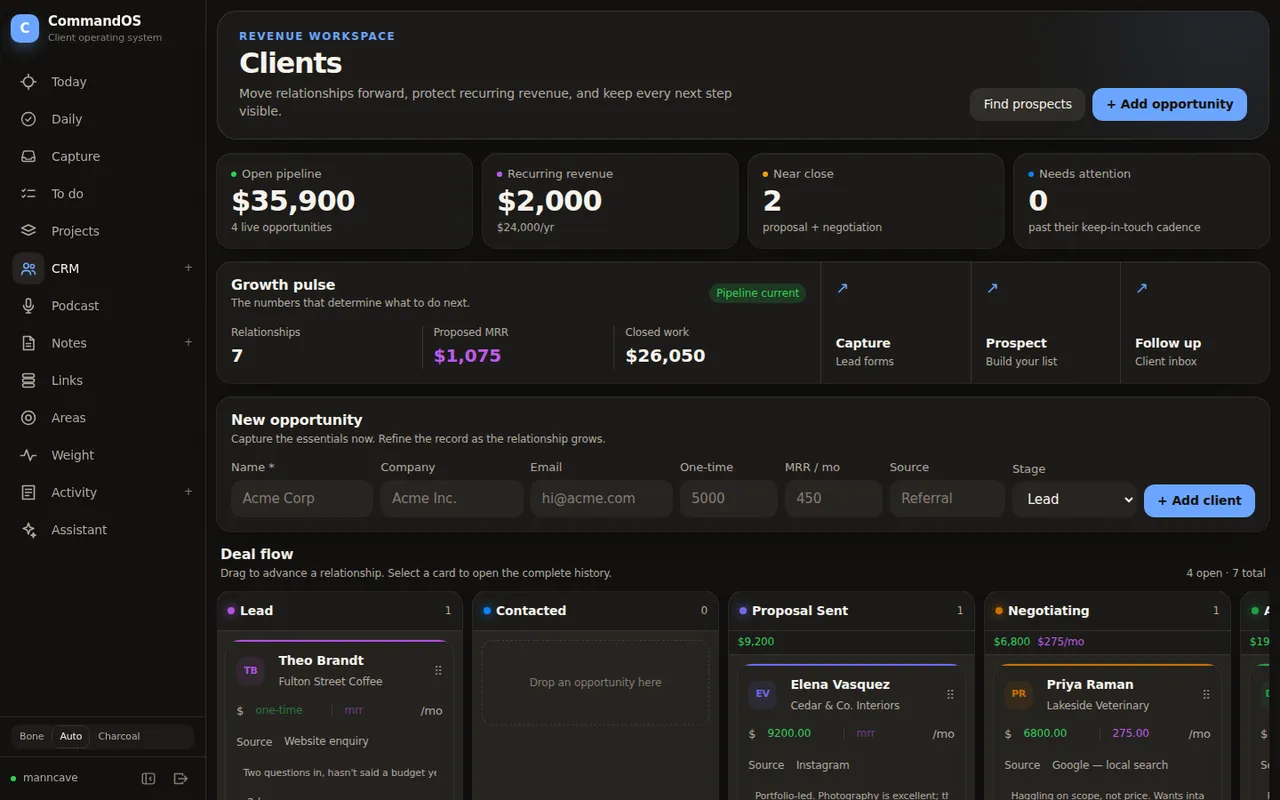
Pipeline — Every client by stage, with the deal value and how long since anyone spoke. -
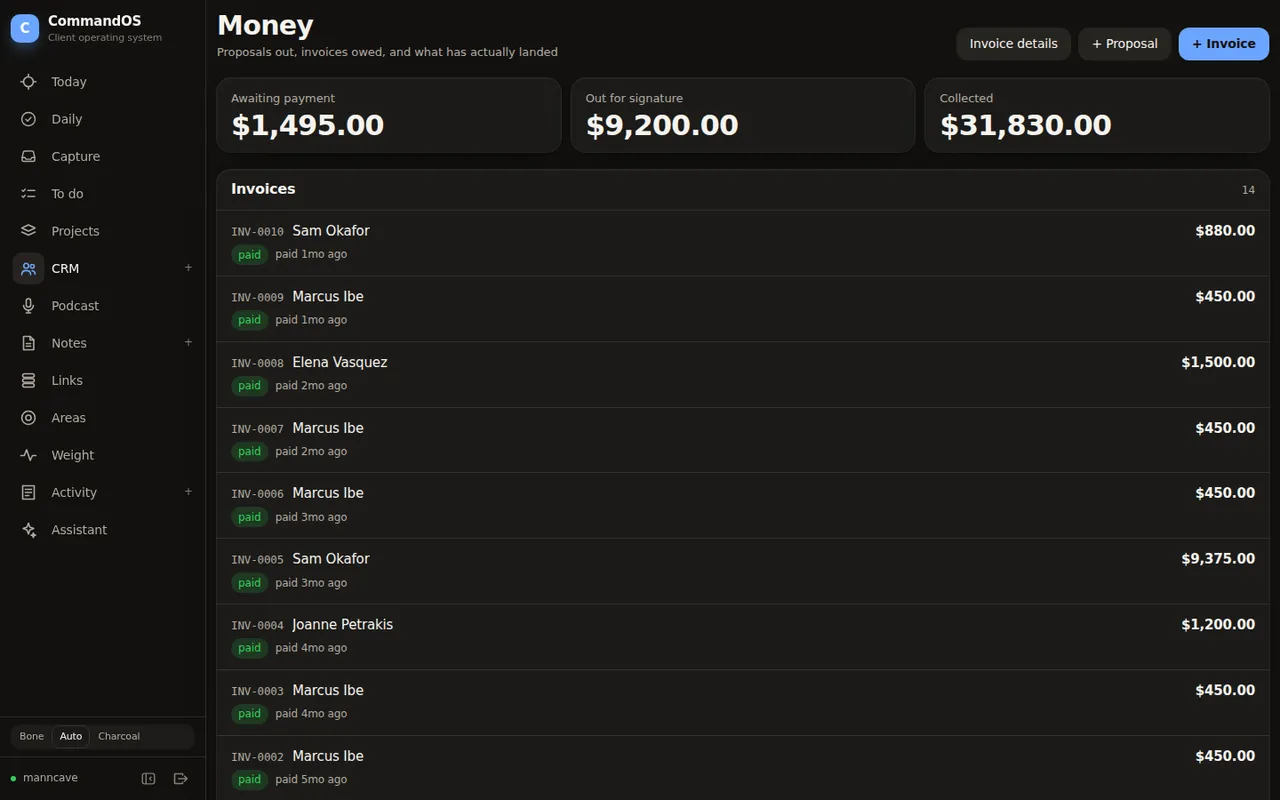
Invoices and proposals — What is out, what is overdue, and what has been signed. -
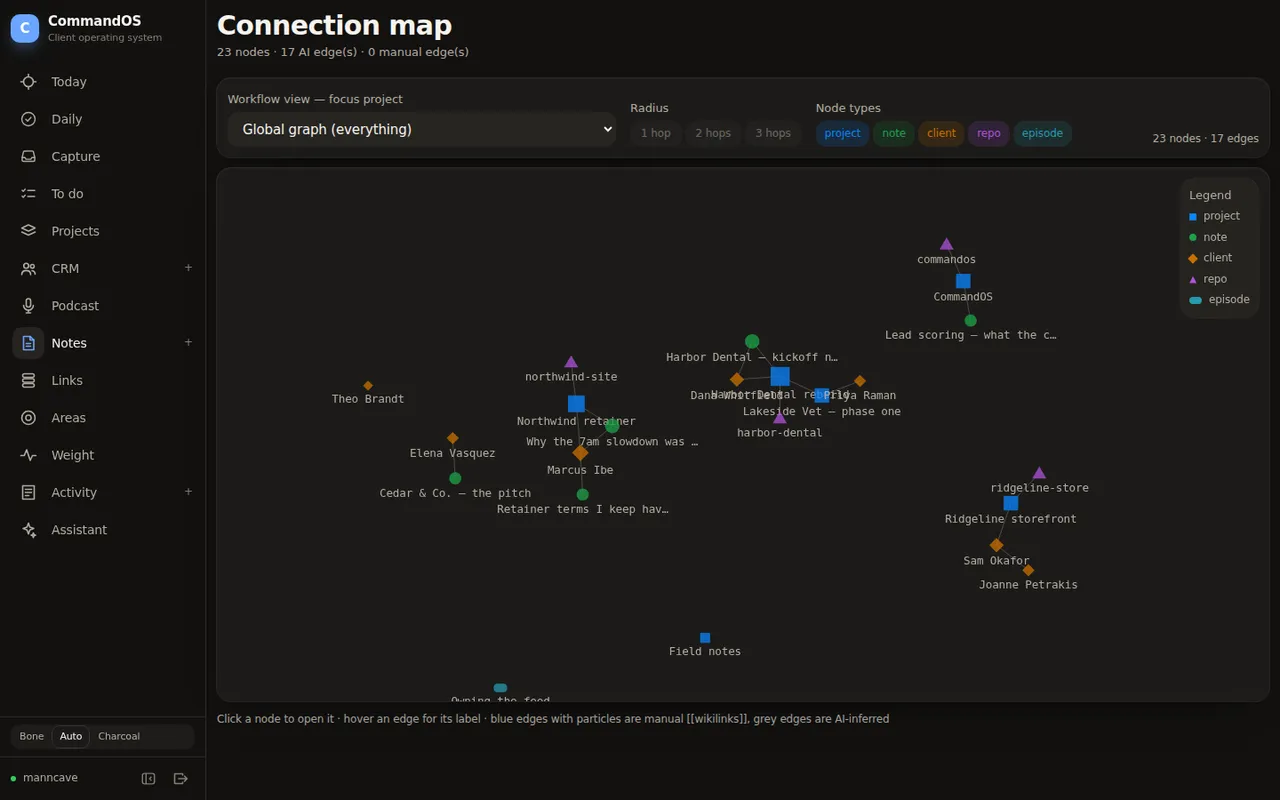
Graph — Notes, projects, clients, repositories and transcribed episodes, and the edges between them. -
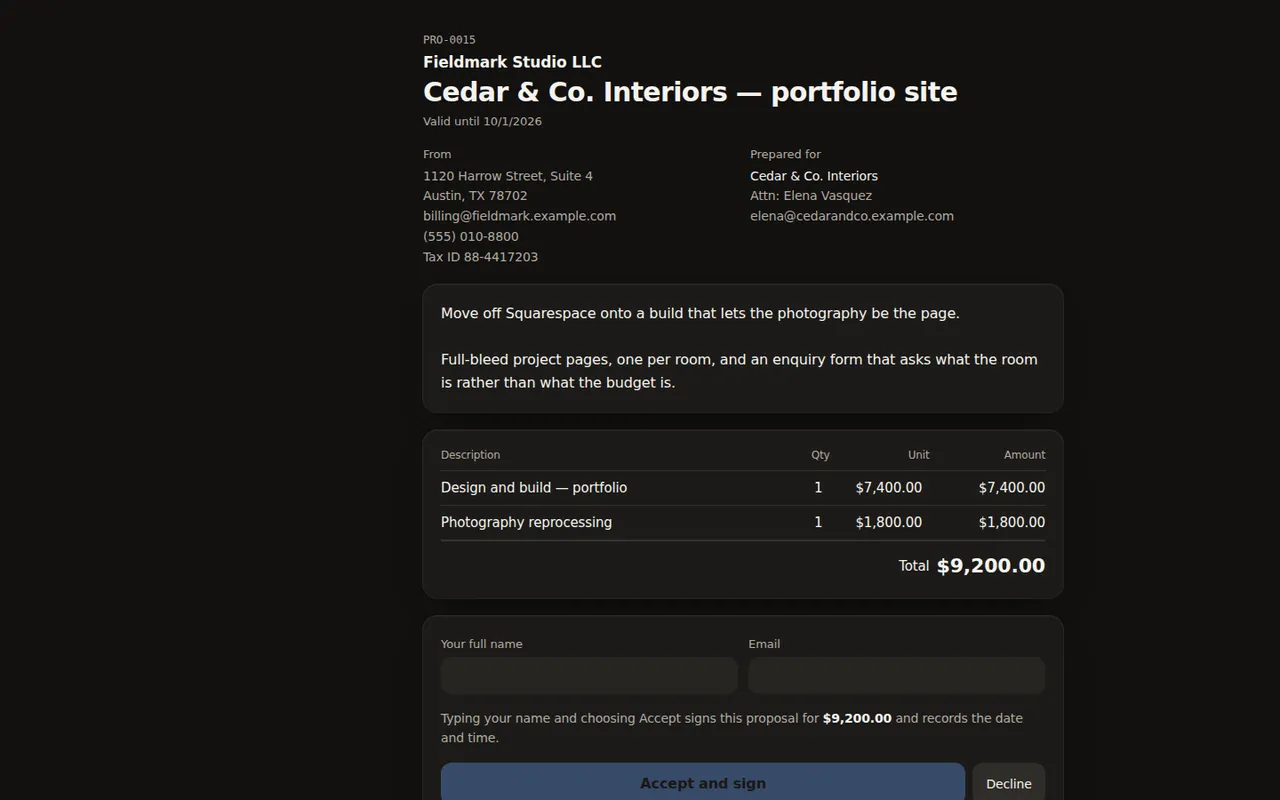
Proposal — Opened from a capability link by someone with no account, and signed in the page. -
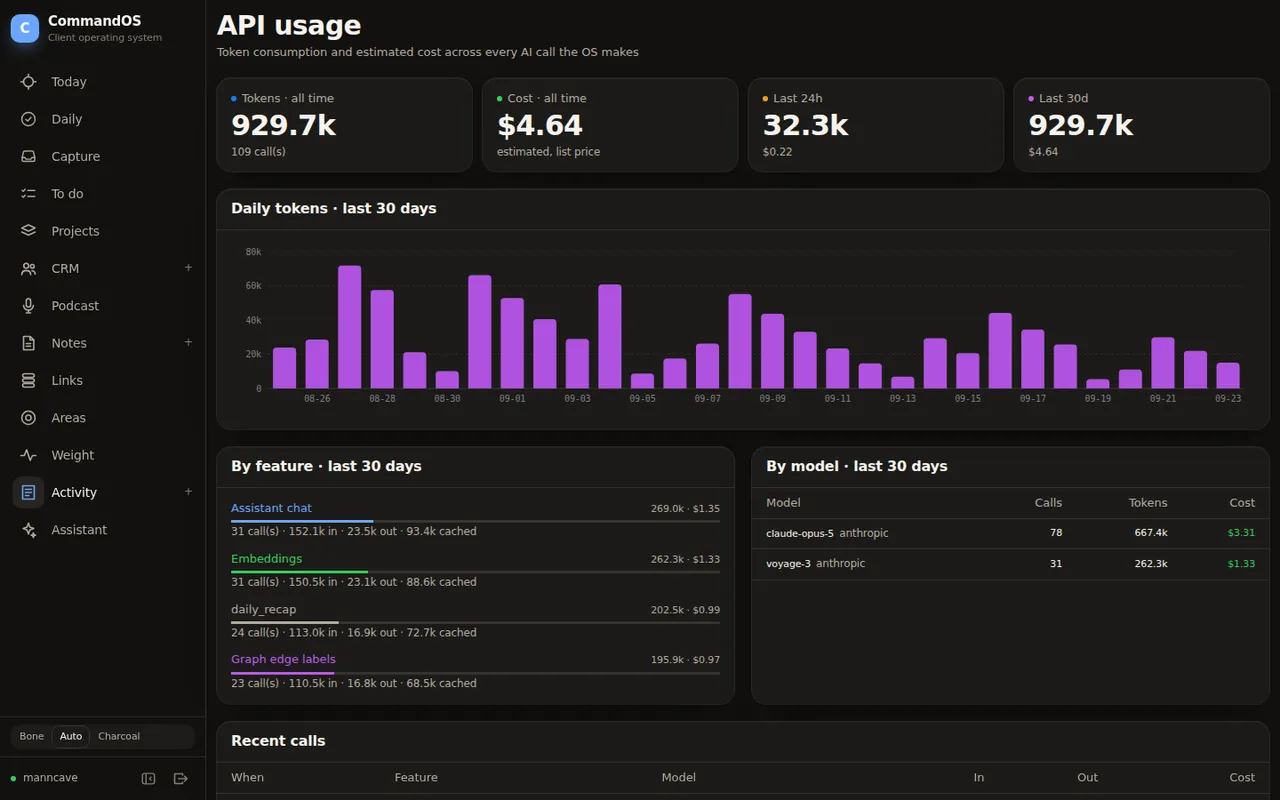
AI spend — Every model call this system makes, by feature, priced to the token.
Where it stands
Running in production as the daily driver, and serving the enquiry form embedded on this site. Single-operator by design, and now the base of a cloud-hosted edition for other businesses: your own instance, run by us. The repository is private; the screenshots below come from the app itself, seeded with an invented studio and fictional clients.
- Tables behind one app
- 55 Tables behind one app
- Client-facing surfaces published
- 5 Client-facing surfaces published
- Tools the AI can write with
- 3 Tools the AI can write with
The offer
Your own CommandOS, hosted by us.
The command center this studio runs on every day, as a cloud-hosted instance of your own. We run the server; you run the business.
$19 /month
Cloud-hosted · your own instance
Next case
Lotline